
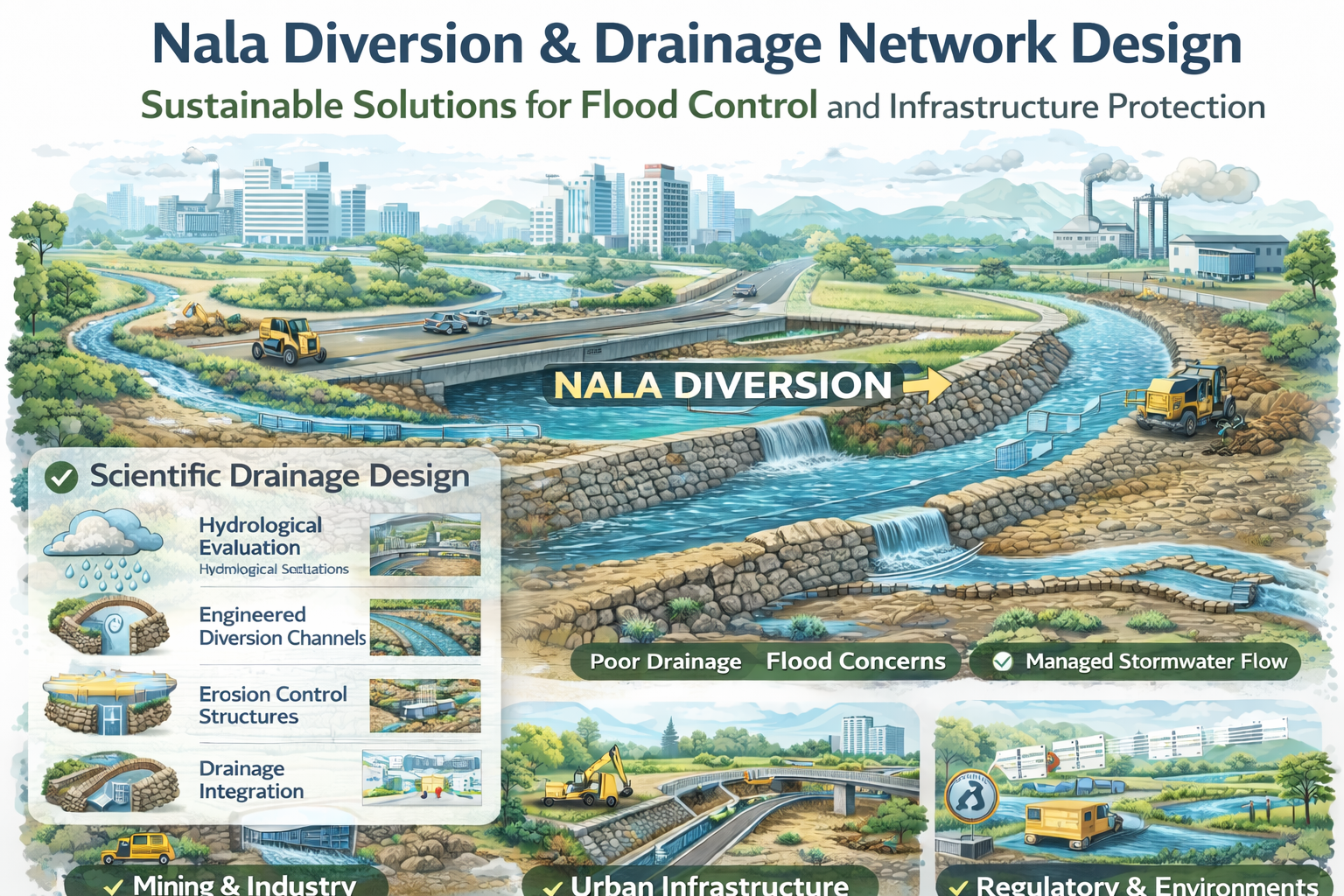
Nala Diversion & Drainage Network Design: Sustainable Solutions for Flood Control and Infrastructure Protection
Introduction
Natural drainage channels—commonly known as nalas—play a critical role in conveying stormwater, maintaining watershed hydrology, and preventing localized flooding. However, rapid urbanization, mining activities, industrial expansion, and infrastructure development often obstruct or alter these natural flow paths. When nalas are encroached, blocked, or poorly modified, the result is waterlogging, flash flooding, erosion, and structural damage.
Nala diversion and drainage network design provide engineered solutions to safely reroute flows while maintaining hydraulic efficiency, environmental integrity, and regulatory compliance. When executed using hydrological analysis and sound engineering principles, nala diversion transforms a flood hazard into a managed water system.
What Is Nala Diversion?
Nala diversion involves rerouting a natural or man-made drainage channel away from project footprints such as:
Mining leases
Industrial plants
Roads, railways, and urban developments
The objective is to restore uninterrupted flow, prevent flooding, and protect both upstream and downstream areas.
Diversion design must ensure:
Hydraulic capacity for peak flows
Structural stability
Minimal environmental and social impact
Importance of Proper Drainage Network Design
Drainage networks function as the arteries of surface water systems. Poorly designed drains often lead to:
Backflow and water stagnation
Channel erosion and siltation
Flooding during high-intensity rainfall
Damage to roads, buildings, and utilities
A scientifically designed drainage network:
Safely conveys runoff
Reduces flood peaks and velocities
Integrates with natural watershed flow
Supports long-term maintenance and resilience
Key Components of Nala Diversion & Drainage Design
1. Hydrological Assessment
The foundation of nala diversion design is hydrological analysis, which includes:
Rainfall analysis and intensity–duration–frequency (IDF) curves
Catchment delineation and runoff estimation
Peak discharge calculation for design return periods
Climate variability considerations
Accurate runoff estimation ensures that the diverted channel can safely carry extreme flows.
2. Hydraulic Design of Diversion Channels
Hydraulic design determines the shape, slope, and lining of the nala:
Channel cross-section (trapezoidal, rectangular, naturalized)
Bed slope and energy gradient
Freeboard and flood safety margin
Velocity control to prevent erosion
Designs are typically validated using hydraulic modelling tools.
3. Structural and Erosion Control Measures
To ensure stability and longevity:
Stone pitching or concrete lining is used in high-velocity reaches
Energy dissipation structures reduce flow velocity
Check structures and drop structures control bed erosion
Bio-engineering measures stabilize banks naturally
These measures balance engineering strength and environmental compatibility.
4. Integration with Existing Drainage and Outfalls
A diversion channel must seamlessly integrate with:
Upstream catchments
Downstream natural streams or rivers
Stormwater drains and culverts
Poor integration often shifts flooding problems downstream, which must be avoided through watershed-level planning.
Applications of Nala Diversion & Drainage Design
Nala diversion is commonly required in:
Mining and mineral processing projects
Industrial and power plants
Highway, railway, and corridor projects
Urban expansion and smart city developments
Flood-prone industrial estates
Each application requires customized design based on land use, topography, and regulatory conditions.
Environmental and Regulatory Considerations
Nala diversion is not just an engineering task—it is a regulated environmental activity.
Key considerations include:
Maintaining downstream flow continuity
Avoiding reduction in natural drainage density
Ensuring no adverse impact on groundwater recharge
Compliance with environmental clearance and water regulations
Environmental impact assessments often require justification of diversion alignment and capacity.
Case Insight: Nala Diversion for a Mining Project
Project Context
A mining project faced seasonal flooding due to a natural nala passing through the lease area.
Challenges
High monsoon runoff
Risk to mine operations and safety
Downstream villages dependent on natural flow
Technical Approach
Catchment-based runoff estimation
Design of peripheral diversion channel
Hydraulic validation for peak monsoon discharge
Integration with downstream drainage
Outcome
Elimination of flooding inside the lease
Safe downstream flow continuity
Regulatory compliance and community acceptance
Role of Hydrodynamic Modeling Consultancy Pvt. Ltd.
Hydrodynamic Modeling Consultancy Pvt. Ltd. provides end-to-end nala diversion and drainage network design services, including:
Catchment and watershed analysis
Runoff and peak flow estimation
Hydraulic design and modelling
Erosion and sediment control planning
Regulatory-ready drawings and reports
Our solutions ensure hydraulic safety, environmental responsibility, and long-term performance.
Why Scientific Nala Diversion Is Essential
Improper nala diversion can:
Increase downstream flood risk
Cause channel instability and erosion
Violate regulatory norms
A science-based approach ensures:
Flood-safe infrastructure
Sustainable surface water management
Climate-resilient development
Conclusion
Nala diversion and drainage network design are critical for managing stormwater in rapidly developing regions. By combining hydrological analysis, hydraulic engineering, and environmental safeguards, diversion systems can protect infrastructure while maintaining natural water flow regimes.
Hydrodynamic Modeling Consultancy Pvt. Ltd. delivers robust, regulator-aligned nala diversion solutions that balance development needs with environmental sustainability.