
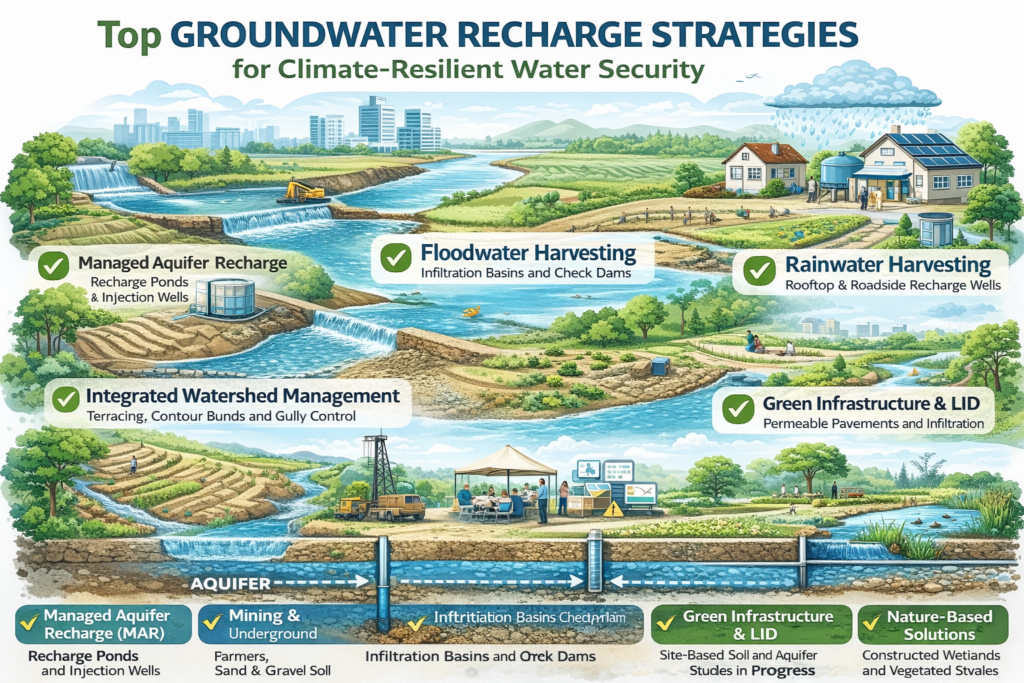
Top Groundwater Recharge Strategies for Climate-Resilient Water Security
Introduction
As climate change intensifies rainfall variability and increases water scarcity in many regions, ensuring climate-resilient water security has become a global priority. Groundwater — the largest source of accessible freshwater in many countries — is under pressure due to over-extraction, pollution, and declining recharge rates. Implementing strategic groundwater recharge initiatives is essential to bolster aquifer storage, reduce dependency on surface water, and enhance resilience to droughts and floods.
This article outlines the top groundwater recharge strategies that can help communities, governments, and industries sustainably manage water resources in a changing climate.
1. Managed Aquifer Recharge (MAR)
Managed Aquifer Recharge (MAR) is one of the most powerful tools to increase groundwater storage intentionally. MAR involves capturing excess surface water (such as stormwater, floodwater, or treated wastewater) and directing it into aquifers for later recovery and use. Water sources used can include river flows, runoff, or reclaimed water.
Key Benefits
Enhances groundwater availability during droughts
Improves water supply reliability
Reduces risks of aquifer depletion
Examples have shown MAR’s success in urban, agricultural, and rural contexts across Africa, Latin America, Asia, and Australia, demonstrating its global applicability and flexibility.
2. Rainwater Harvesting (RWH)
Rainwater harvesting captures rain runoff from rooftops, landscapes, paved surfaces, or catchment areas and stores it for either direct use or infiltration. When designed with infiltration systems (like recharge wells, pits, or trenches), harvested rainwater significantly contributes to aquifer recharge.
Practical Techniques
Roof-based rainwater harvesting: Water is collected from roofs and directed into recharge structures.
Infiltration wells: These wells carry water below the root zone to enhance percolation.
Storage dams combined with recharge wells: Especially effective in arid zones where runoff is sudden and intense.
Such systems are being expanded in urban and rural India to improve recharge and reduce waterlogging and flood impacts.
3. Floodwater Harvesting and Infiltration Basins
Floodwaters — often viewed solely as disasters — can be harnessed for groundwater recharge. Floodwater harvesting structures, such as infiltration basins, percolation ponds, and check dams, slow runoff so that water percolates into the ground rather than rapidly flowing to rivers and seas.
How It Works
Spreading grounds/infiltration basins: Shallow artificial ponds retain runoff long enough for it to infiltrate.
Percolation ponds & check dams: Spread water across permeable soils and enhance vertical recharge.
These structures not only recharge aquifers but also help in flood mitigation, soil erosion control, and improving local micro-climates.
4. Integrated Watershed Management
Recharge is most effective when part of a broader watershed management approach. Soil and water conservation interventions — such as contour bunding, terracing, vegetative cover enhancement, and gully control — improve infiltration and reduce surface runoff.
Benefits
Promotes long-term recharge sustainability
Improves soil moisture and base flows
Reduces sedimentation in reservoirs and rivers
A watershed approach looks at the entire hydrological system, ensuring that recharge strategies complement land use and agricultural practice changes.
5. Green Infrastructure and Urban Water Management
In urban areas, where impervious surfaces limit infiltration, strategies such as sponge city designs, permeable pavements, and infiltration trenches enhance distributed recharge. This type of integrated urban water management treats stormwater, rainwater, and wastewater as part of a connected water cycle, improving overall water security.
Example Techniques
Hollow paver blocks in sidewalks and parks to let rainwater percolate into soils
Retention tanks beneath school grounds to capture stormwater and recharge aquifers through infiltration systems (recent pilot programs show promising flood reduction and recharge benefits)
These approaches deliver dual benefits: reducing flood risk and enhancing groundwater levels.
6. Nature-Based Solutions and Low Impact Development (LID)
Nature-based solutions, like constructed wetlands, vegetated swales, and bio-retention cells, work with natural processes to slow runoff and facilitate infiltration. Approaches such as Low Impact Development (LID) designs also mimic pre-development hydrology, emphasizing infiltration and storage close to where rain falls.
7. Community-Led and Policy-Driven Approaches
Sustainable recharge initiatives must be supported by strong policy frameworks, community engagement, and inclusive water governance. Examples from India show how government–community partnerships and local governance programs can successfully implement recharge structures and reduce dependency on external water sources.
Policy & Investment Priorities
Prioritize recharge structures in water policy
Incentivize rainwater harvesting in building codes
Use digital monitoring and data to optimize recharge investments
8. Tailoring Recharge to Local Hydrogeology
No single recharge strategy is universally optimal. A site-specific hydrogeological assessment ensures recharge structures are appropriately designed, considering soil permeability, aquifer characteristics, and water quality.
Technique selection — from infiltration basins to deep injection wells — depends on soil types, aquifer depth, and expected recharge volume.
Conclusion
With climate change driving greater uncertainty in rainfall patterns and water cycles, groundwater recharge strategies are essential tools in building resilient water systems. By combining engineered solutions like MAR, rainwater harvesting, and infiltration basins with watershed management, urban green infrastructure, and nature-based solutions, communities can boost aquifer storage, reduce vulnerability to droughts and floods, and ensure long-term water security.
To be successful, recharge strategies must be scientifically planned, locally adapted, sustainably governed, and socially inclusive.